./run fine-tuning-estrazione-knowledge-graph-lezione-dati
Relation F1 at 0.38: when the lesson wasn't the model, but the data
Technical diary of a fine-tuning: LoRA on a 27B model to extract knowledge graphs from messy documents. The turning point wasn't a bigger model…
- status
- alive
- updated
- 2026-09-18
- tags
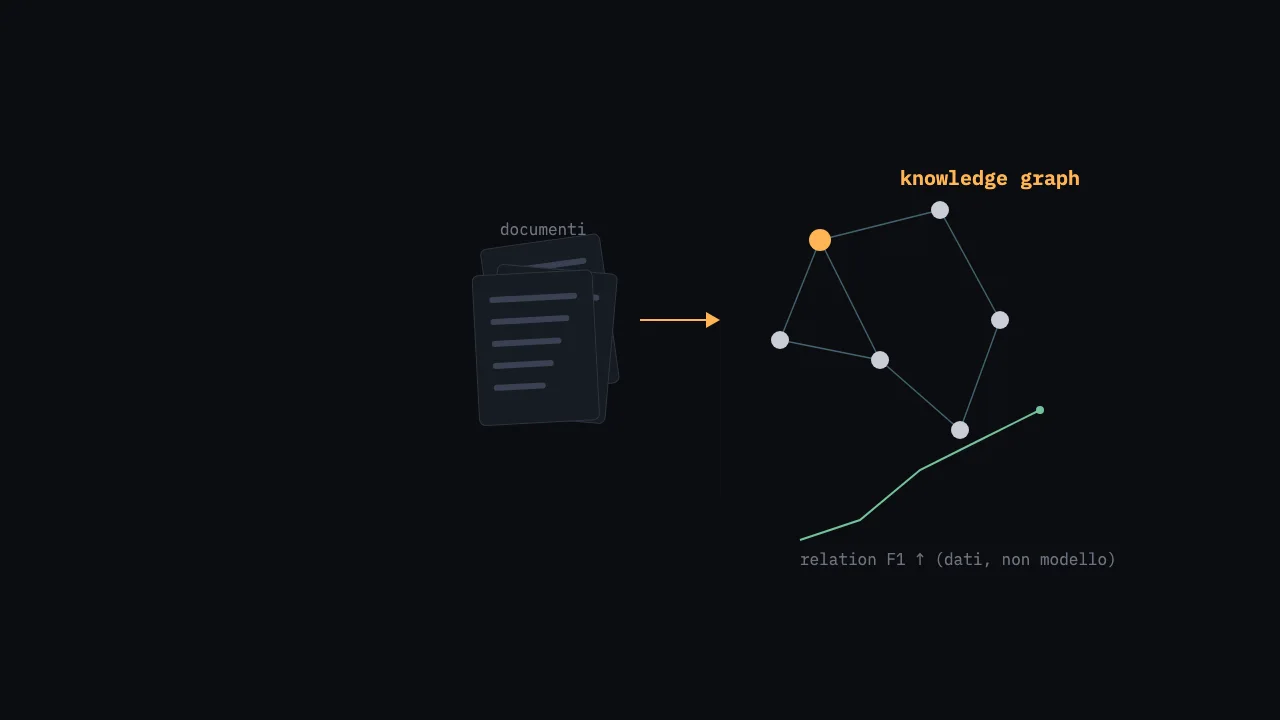
This is the project I can tell the least about in detail, and that’s fine: the domain stays out. But I can explain the technical lesson in full, and it holds for anyone working with LLMs. In one line: before you change the model, look at the data.
The task
Long, dirty text, in Italian → a knowledge graph in JSON. Each document is split into segments; the target of each is an object with this shape:
entities: list of{name, type}— typed nodes with a canonical namerelations: list of{subject, predicate, object, evidence_text}— typed directed edges, plus the textual quote that proves them
With a hard constraint imposed in the schema: subject and object must be exactly a name present in entities — the graph must be internally coherent. The vocabulary is closed: a fixed enum of entity types and predicates.
The model and the fine-tuning
I start from a dense base model of ~27B, and do LoRA/SFT (PEFT + TRL). No training from scratch: I update 0.58% of the parameters.
mods7 = ["q_proj","k_proj","v_proj","o_proj","gate_proj","up_proj","down_proj"]
target = r".*language_model.*\.(" + "|".join(mods7) + r")$"  # salta la vision tower
LoraConfig(r=32, lora_alpha=64, lora_dropout=0.1,
           target_modules=target, bias="none", task_type="CAUSAL_LM")
# bf16, grad-checkpointing, lr=2e-4 cosine, micro_bs=1 x grad_accum=8,
# cutoff 16384 token, ~4 epoche, best su eval_loss + early stopping
The serving is vLLM with multi-LoRA: the base stays resident once, the adapters attach as named modules — multiple fine-tunings share the same base. It runs on on-prem HPC (2 GPUs, H200 class, Slurm), bound only to loopback, tracked in MLflow — where only aggregates end up, never raw text or generations.
The turning point (which is the whole project)
I trained v1, froze it and put it in production. It worked. And then I made the classic mistake: thinking that to improve I needed a bigger model.
Wrong. Looking at where it went wrong, the picture was clear:
- Entities: F1 ~0.68-0.71, decent.
- Relations: F1 ~0.38-0.41, weak.
And the weakness was concentrated in the rare tail: predicates with fewer than 500 examples scored ~0.00, with a clear correlation between rarity and F1. The root cause, once I found it, was embarrassing and instructive: the rich schema had been added after the corpus was already annotated. Documents that were textbook examples of a new relation extracted ~0 of it, because what was missing wasn’t the text — it was the annotation layer.
So the lever wasn’t “more documents” (tried: yields ~0). It was re-annotating the existing text under the new schema.
v2 is data engineering, not model engineering
Three moves, all quantified:
- Schema widening — new predicates enumerated from the data, never invented.
- Fine re-annotation — same text, sharper labels (remap the volume of a coarse catch-all onto the precise directional children).
- Tail densification — previously empty predicates filled with delta re-annotation on ~1,800 candidate chunks.
And a discipline I really liked: learnable vs measurable as a split constraint. The test set is chosen by a deterministic greedy selector that must cover every priority predicate with ≥30 test instances (measurability) without dropping any predicate below 50 in training (learnability). Where the two objectives conflict, the predicate is declared “learnable but not measurable on this split” — kept and trained, excluded from the metric. Not thrown away.
Measuring honestly
- Micro P/R/F1 separate for entities and relations, with greedy one-to-one matching.
- Alias-aware scoring: gives credit if the form matches any known variant of the gold entity, not just the canonical name — separates real errors from mere naming variance (relation F1 0.38→0.41).
- Two audits beyond F1: I sample the false positives and check whether both endpoints and the quote actually appear in the chunk (≈47% of the “errors” were correct extractions missing from the gold — incompleteness of the annotation, not of the model); and I verify that the
evidence_textof the true positives is verbatim in the text (~87.5%, an anti-hallucination check).
What I learned
The base was already large, and its entities were strong; scaling it up wouldn’t have manufactured relations that the gold didn’t contain. The audits said it plainly: a big slice of the “false positives” were correct extractions absent from the annotation. It’s the same pattern as the public record (TACRED→Re-TACRED, +16 F1 just by cleaning the gold, architecture unchanged).
Not very exciting to put on a slide. But it’s what moved the needle: in an extraction project, the product isn’t the model — it’s the curated dataset behind it. The model is replaceable. A well-built gold standard is not.
Updates
2026-09Parity is a result, not a failure
I closed out v2 with two LoRA adapters on the same 27B base model — one relational, one for the timeline — and the honest certification says parity, not a win: relations 0.296 against 0.281 for the previous version, entities 0.478 against 0.484, with the paired bootstrap confidence intervals containing zero on both axes, but over a harder label space (31 predicates instead of 24) and with one capability more than existed before. The piece that moved the needle wasn’t a re-train but the serving stack: schema-constrained generation with caps on the item counts, alias-aware grounding, and a role-signature filter that discards 12.2% of the type-incoherent relations — and alias-aware grounding alone closed the entity gap (+0.044 F1) I had diagnosed as a recall deficit from training. The counterintuitive part is that the same stack applied to the old model makes it worse (−0.081 F1), because it treats a degeneration only the new one produces: the honest comparison isn’t “both under serving” but “each at the configuration it actually ships with”. For robust numbers I ran a 5-fold document-level k-fold, leakage-safe: 0.287 ± 0.009 on relations, 0.510 ± 0.012 on entities, 0.353 ± 0.017 on events; tight deviations, and the single deployment split comes out representative on relations and even pessimistic on entities. Decomposing the errors then closed the loop on the earlier lesson about data: roughly 87% of the false negatives have both endpoints visible in the segment, so this time the ceiling is the model, not the annotation — and the rare tail stays weak but only weighs 15% of the instances, while the aggregate is stuck because the head predicates sit at ~0.34. Artifacts frozen read-only with checksums and a manifest; the actual release is a decision for whoever owns the system, not mine.
For confidentiality, the domain and contents stay out of the diary. I tell the method, not the subject matter.
grep -rl 'same thread' ~/lab
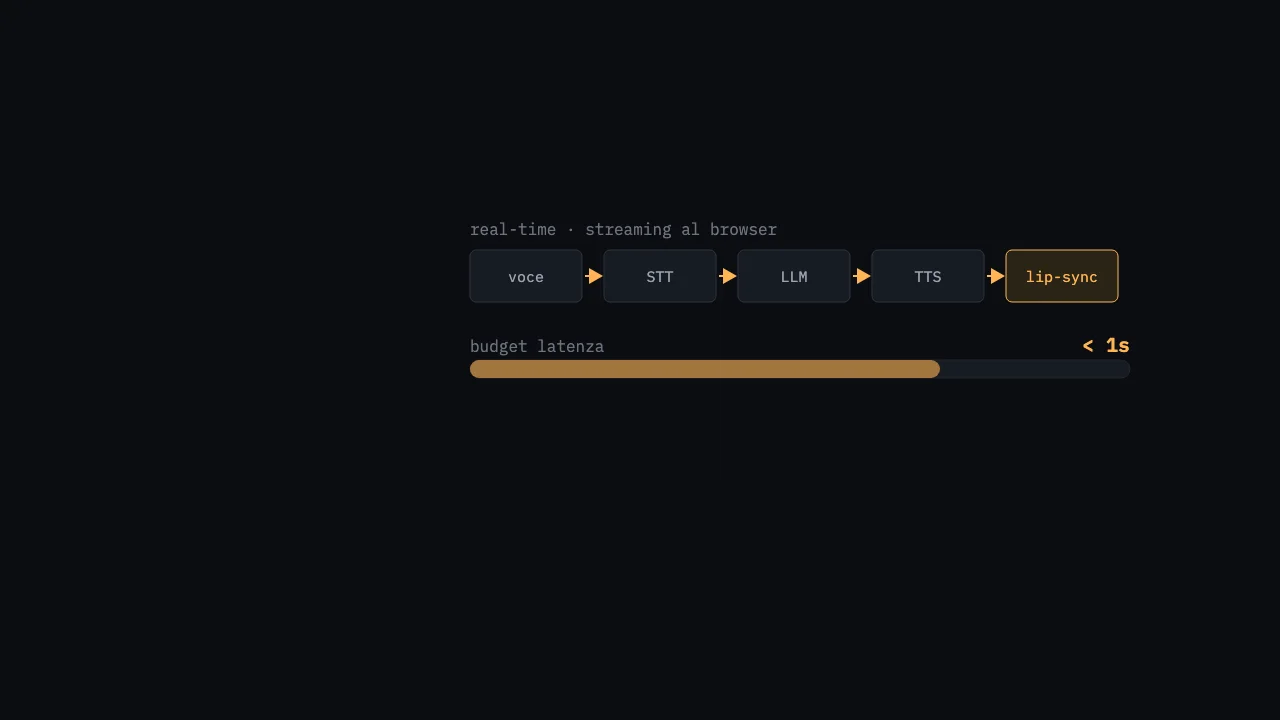
The avatar that talks before it moves its lips
Diary of a real-time conversational AI avatar: STT, LLM, TTS and lip-sync on GPU. The hard decision was decoupling audio from video.
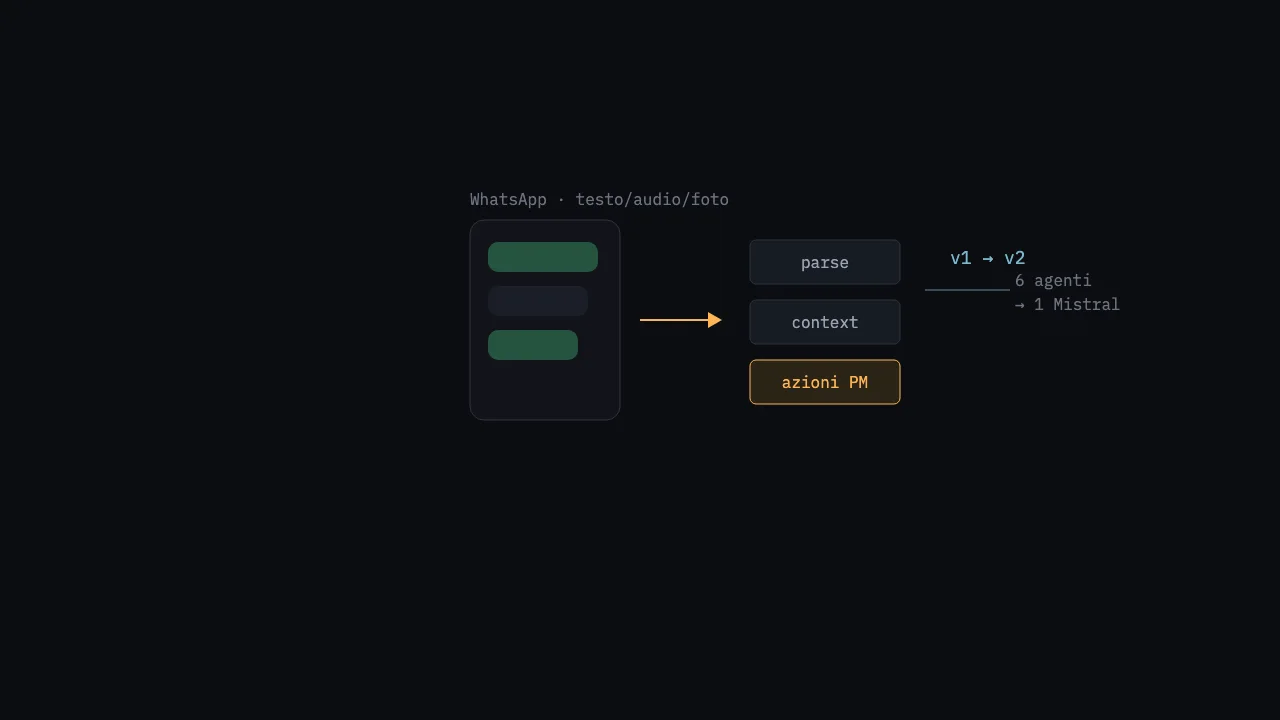
Pragma, twice: I threw out six agents and two databases, and gained a feature that weighs 1
I rebuilt a WhatsApp project-management assistant for the public sector from scratch: from six agents and three databases to just one. A diary on which complexity…
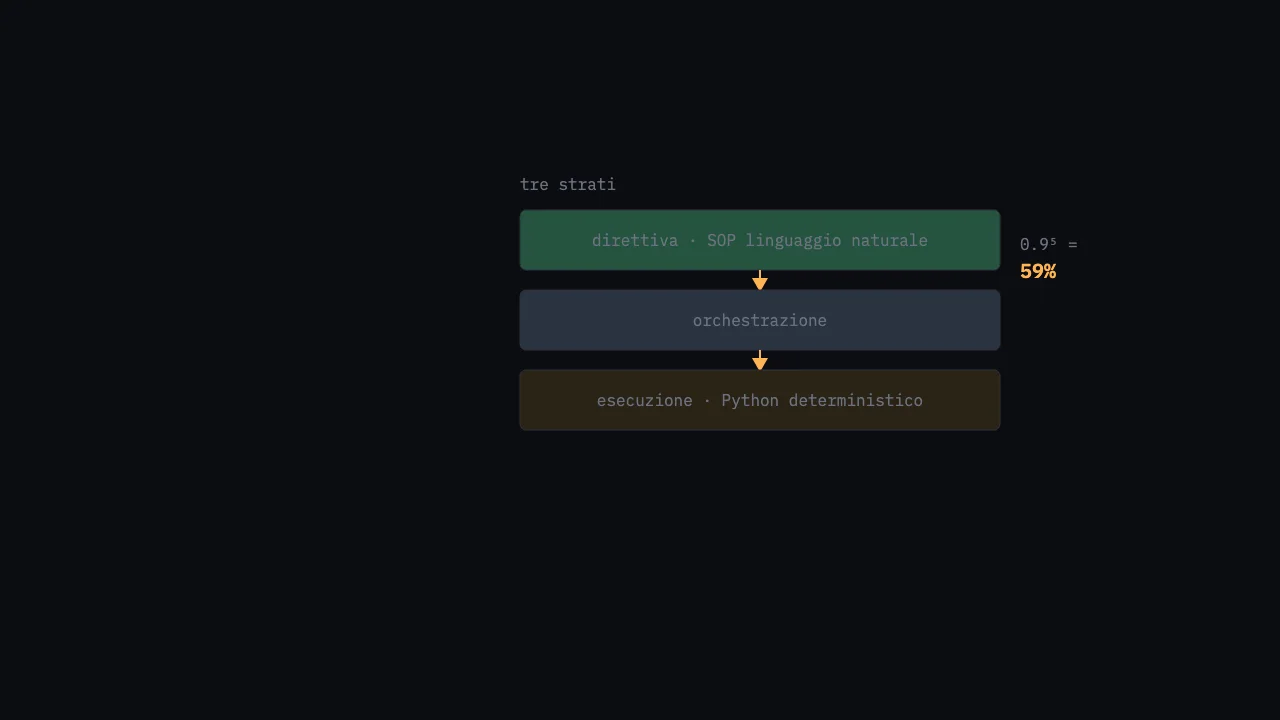
The 59%: why I stopped letting the LLM do everything
Diary of a multi-agent scaffold on Agno: three layers directive/orchestration/execution, natural-language SOPs on top, deterministic Python underneath…