./run prezzato-mercato-gpu-noleggio-affitto-vs-acquisto
I was about to buy a GPU. I priced the entire rental market and changed my mind.
Technical journal: I priced the entire cloud GPU market (RunPod, Vast.ai, Lambda, Modal) to figure out when renting beats buying. The headline price…
- status
- research
- project
- rentGPU
- updated
- 2026-07-08
- tags
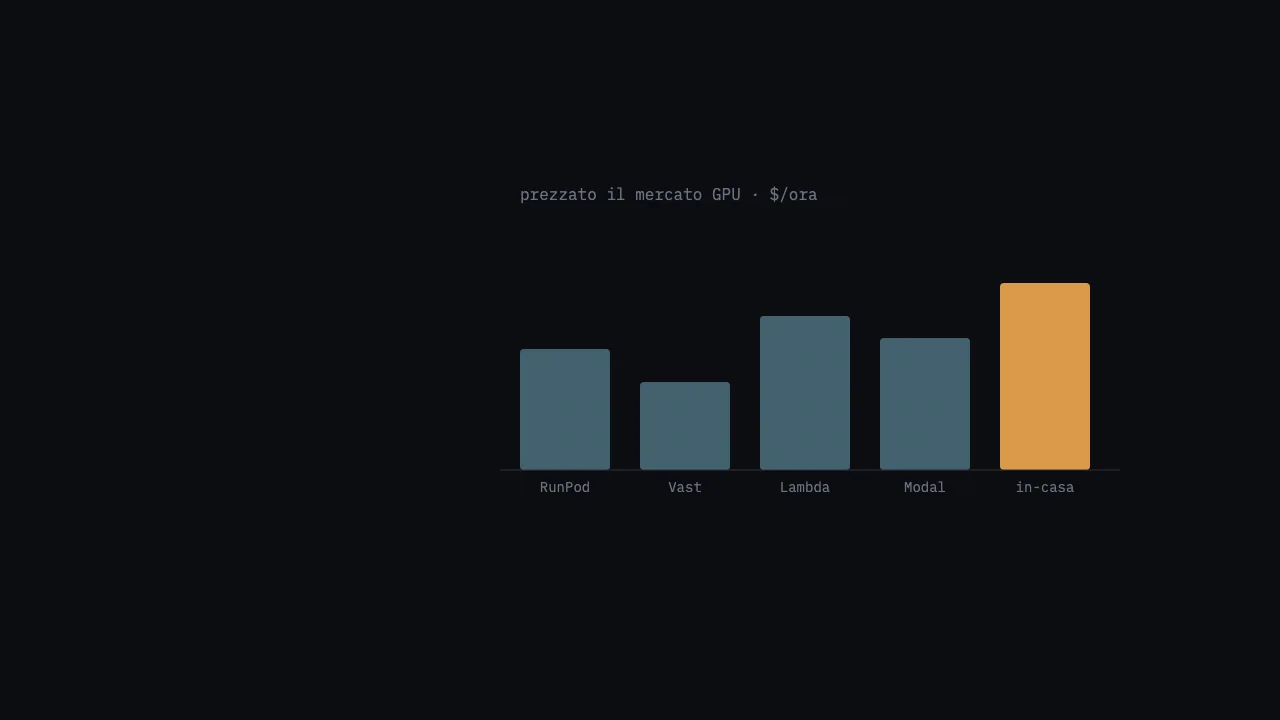
I had the quote open in one tab: an H100, just under 30,000 euros, plus power and cooling. In the other tab, a provider renting me the same card for $1.99/hour. The trivial question — “is it worth buying?” — turned out to be the least trivial one of the project. So I did the most boring thing possible: I priced the entire market of rental GPUs, provider by provider, tier by tier, and I wrote down the math. The discovery wasn’t a price. It was that the shop-window price almost always lies.
The idea: a single sheet of pricing truth
Not a tool, a research notebook: a taxonomy of the market plus a comparable price snapshot, current as of mid-2026. The goal was to answer three questions with numbers, not gut feelings: who’s actually cheapest, when renting beats buying, and which billing meter screws you while you’re staring at the hourly price.
The market splits into three, not twenty
The first useful thing was to stop comparing 20 names and instead see 3 categories, each with a different promise:
- Marketplace / P2P — individuals and datacenters rent out unused GPUs. Lowest prices in absolute terms, variable reliability. Vast.ai (over 20,000 GPUs, 40+ datacenters), Spheron with H100 SXM5 spot seen at $1.03/hour, the lowest I came across.
- Specialized GPU clouds — built for AI, a good price/reliability compromise. RunPod is the reference point (99% SLA on Secure Cloud), then Lambda Labs (99.9%, zero egress fees), CoreWeave, Hyperstack, Thunder Compute.
- Serverless / inference — no instances to manage, autoscale from 0 to N, per-second billing. Modal (scale-to-zero, the best for idle), Replicate, Baseten, Fal, RunPod Serverless.
That three-way split is the real product of the research: it says that “cloud GPU” isn’t one market, it’s three, and mixing them up is the mistake that blows up your bill.
The snapshot that matters: H100, same tier, all lined up
The core is a single table, with the exact same chip (H100 80GB) and prices sorted. Sanitized, here it is:
| Provider | On-demand $/h | Spot $/h |
|---|---|---|
| Spheron | 2.50 (SXM5) | 1.03 |
| RunPod | 1.99 PCIe / 2.69 SXM | ~1.19 |
| Thunder Compute | 1.38 | — |
| Lambda Labs | 2.49 (egress free) | — |
| Vast.ai | 3.29 (on sale ~1.49) | varies |
| Modal (serverless) | 3.95 | — |
| Replicate (serverless) | 5.49 | — |
| AWS p5 | ~6.88 | — |
| Azure | ~12.29 | — |
Two immediate takeaways. First: the hyperscalers cost 2–5× a specialized cloud for the same GPU-hour — paying Azure $12.29/h for an H100 that RunPod gives you at 1.99 is a distraction tax. Second, the figure that surprised me most: the H100 has crashed 64–75% in 18 months, from the $8–10/hour of Q4 2024 to the $2–3/hour of early 2026. The hardware I was about to buy for 30,000 € was depreciating while I was doing the math. This alone kills most of the “I’ll buy” argument.
The catch: buying beats renting only past a precise threshold
Redoing the math by hand, buying makes sense in exactly one case, and it has a number. Take my H100 at $1.99/h on RunPod. Using it 24/7 for a full year = 8,760 hours × 1.99 = ~$17,400/year. The hardware is ~$25–40,000 of capex (my quote was around 30k€) plus energy (an H100 draws ~700 W: running flat out, thousands of dollars a year) plus cooling, maintenance, and obsolescence. Do the subtraction:
- At full utilization (100%, 24/7), renting costs ~17k/year: the break-even with hardware arrives around 2 years. And in those 2 years the rental has dropped 65%, while your card has aged.
- At realistic utilization (~50%), renting halves to ~8.7k/year: the fixed capex doesn’t move, and break-even slips past 3–4 years.
Hence the blunt rule I extracted from the research: you buy only with sustained utilization >50–60% 24/7 over 1–3 years — or when compliance / data residency forces you onto hardware. For everything else — bursty jobs, experiments, one-off fine-tuning, brand-new silicon (H200, B200, GB200) with no capex — you rent. I closed the quote tab.
The headline price lies: the four hidden meters
The part that makes the research useful isn’t the table, it’s the cost levers you don’t see in the hourly price. The four I learned to check before the $/h:
- Spot interruption. Vast.ai kills a spot instance with 15 seconds of notice. Spot costs 40–60% less, but if you don’t checkpoint frequently you’ll eat those savings back in restarts. Use spot only for fault-tolerant jobs.
- Egress. Hyperscalers bill you for outbound data; Lambda and RunPod often don’t. With big datasets, egress can exceed the cost of the GPU itself.
- Idle billing. Per-second (Modal) > per-minute (Jarvis Labs) > per-hour. On spiky traffic, granularity is everything: Modal minimizes idle, others charge you as long as the instance runs. Look at the meter’s model, not just the rate.
- Lock-in. Serverless platforms (Modal, Baseten) package your code into their framework. A pod is a portable Docker; a serverless deploy is a marriage.
There’s also the opposite trap: paying H100 prices for work that runs on a consumer RTX 4090 ($0.34–0.69/h). For Stable Diffusion and models under 13B, the consumer card’s price/performance ratio is unbeatable. The most expensive chip is almost never the right choice.
How it’s going (actual status)
It’s research, not a deploy: a living notebook, not a product. The price snapshot is reliable as of mid-2026, but its very premise is that it ages fast — rates have dropped ~65% in 18 months and change every week, with strong regional variance. The value isn’t today’s exact figure; it’s the structure — the three categories, the break-even threshold, the four hidden meters — that stays valid when the numbers move. The one operating rule I wrote at the top of the file is exactly that: always check the live price before you commit.
What I learned
That “how much does it cost” is the wrong question. The right one is “for how long and how regularly will I use it” — because it’s utilization, not the hourly price, that decides rent-vs-buy. That in a market depreciating 65% in a year and a half, buying hardware is betting against time, and you almost always lose. And that the shop-window price is the least informative of the numbers: the real levers — spot dying in 15 seconds, egress, meter granularity, framework lock-in — are all in the fine print. I opened the project to answer “buy or rent?”. I closed it having realized that, for the way I work, the answer was already in the way I was asking the question.
grep -rl 'same thread' ~/lab
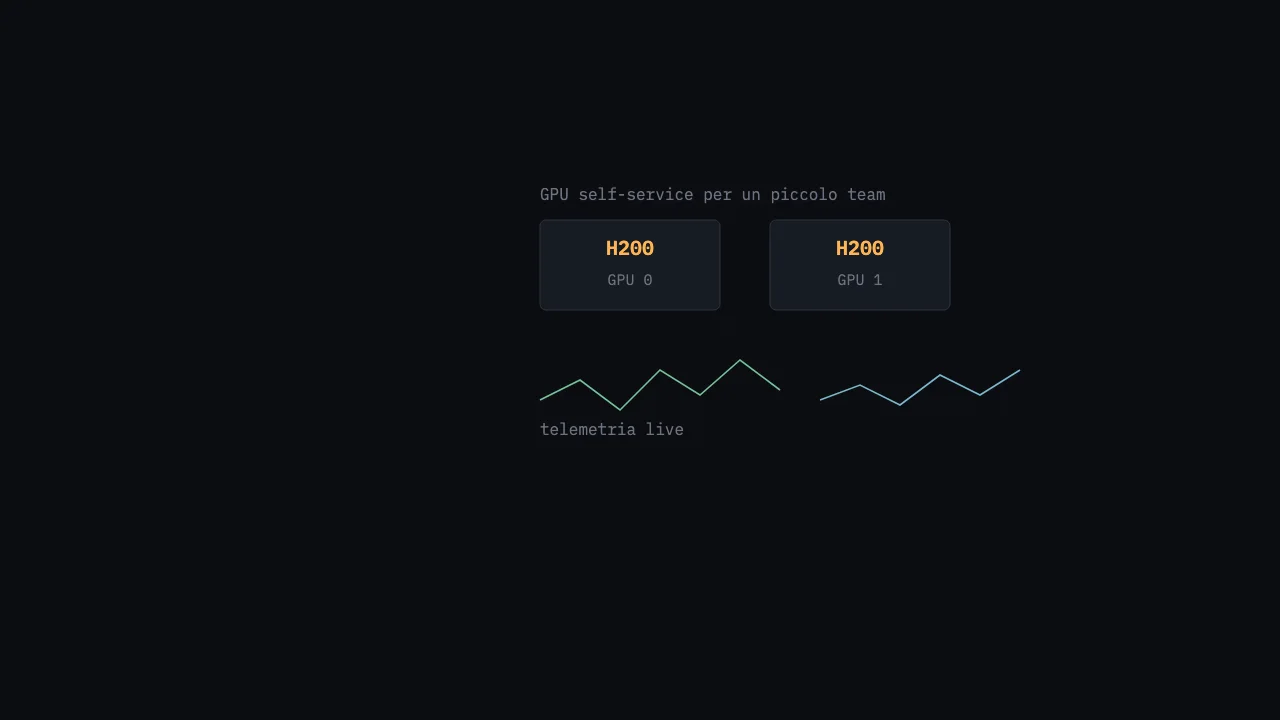
A silent rename, half the apps at 404: home-made RunPod on two H200s
I rebuilt the RunPod + Weights & Biases experience for a small team on two H200s, on top of Slurm. Then a model rename broke everything silently.
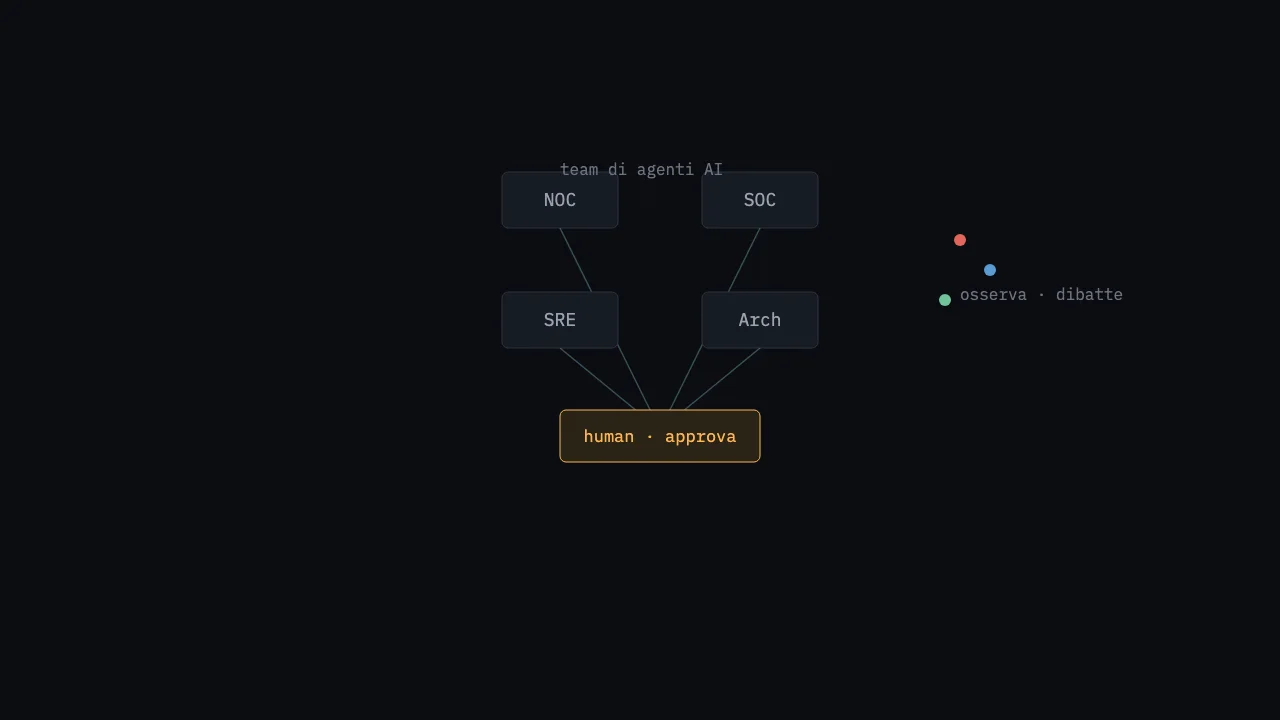
The IT department that argues with itself: three layers and a human in the loop
An IT department made of AI agents — NOC, SOC, SRE, Architecture Board — that watch a k8s cluster, rebut each other and prepare decisions for a…
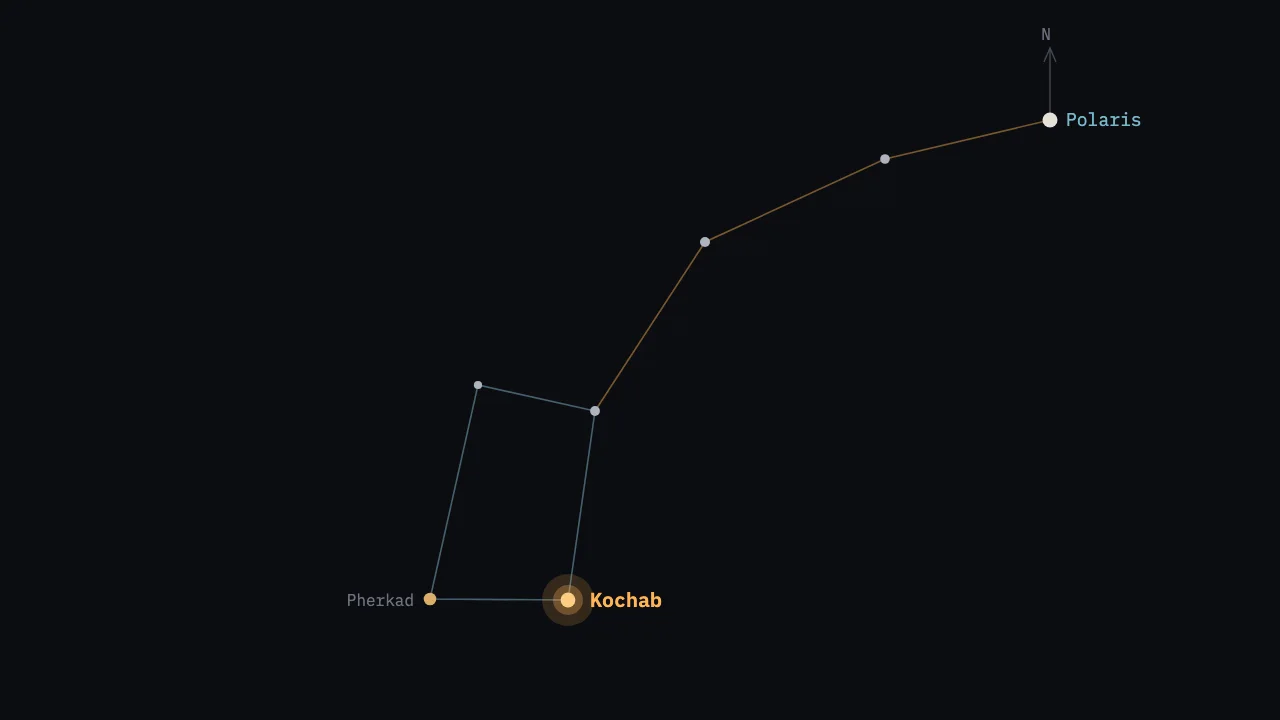
Kochab: building trust into code — the star that never deletes
Technical diary of Kochab: an outbound-only agent in Go, a security audit mapped to CIS/NIST, Ed25519-signed tasks, and one rule — it never deletes — guaranteed…