./run irrigazione-ai-giardino-autonomo
A wrong character flooded the birch: diary of an autonomous irrigation system
A technical diary of an autonomous irrigation system: a FAO-56 agronomic model, an AI agent that reviews the plan every night, and a proprietary protocol decoded…
- status
- shipped
- project
- irrigazione
- updated
- 2026-09-18
- tags
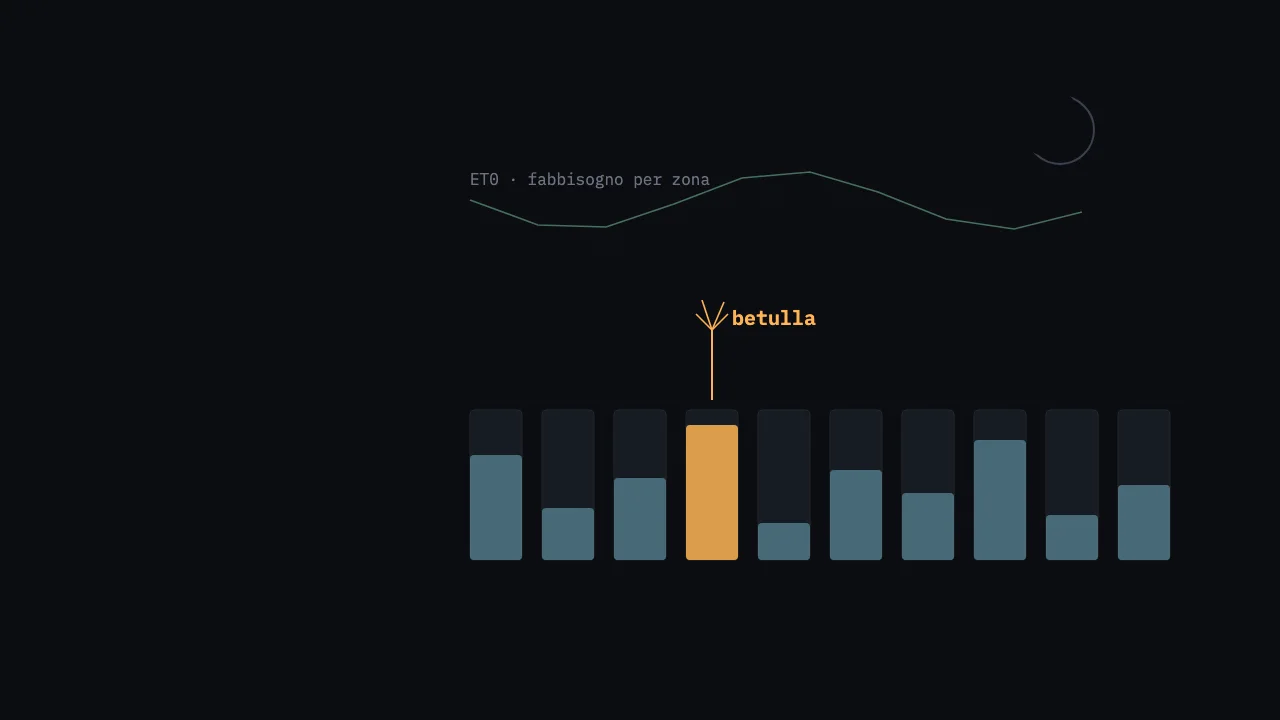
One night the system opened a zone for an hour instead of seventeen minutes and flooded the birch bed — the plant I care about most. I found out from the security camera, not from a log. A wrong character in the way I was communicating with the controller. That bug is the reason this project got serious.
The idea
A timer-based system is dumb: it waters at 6 whether it’s raining or shining. I wanted something that would reason zone by zone. My garden is 2,500 m², 10 zones, 3 wireless controllers. Every night the system computes how much water each one needs, an AI agent reviews the plan, and the controllers execute on their own.
The physical model before the AI
The heart isn’t the AI: it’s the agronomy. I use ET0 per FAO-56 (reference evapotranspiration) plus the soil moisture sensors. The per-zone demand is pure FAO-56 water balance — no numbers hardcoded by hand, every parameter has a value, a confidence and a provenance:
@property
def taw_mm(self):   # Total Available Water: acqua totale disponibile
    return max(0.0, (self.field_capacity_pct/100 - self.wilting_pct/100)
                     * self.root_depth_mm)
@property
def raw_mm(self):   # Readily Available Water = p · TAW
    return self.depletion_fraction * self.taw_mm
@property
def max_session_mm(self):   # mai riempire troppo in un colpo
    ceiling = 8.0 if self.soil_texture == "peat" else 12.0
    return min(0.6 * self.raw_mm, ceiling)
The plant coefficients (Kc, root depth) come from the FAO-56 tables, the soil properties from the USDA textural class. The sensor, though, beats the math: if a real probe reads below the stress threshold, the zone becomes critical and the urgency shoots to 80-100, regardless of the forecasts. With one trick: after heavy rain, a probe under the tree canopy (where the rain didn’t reach) reads “dry” — and it must be ignored, otherwise I water for nothing.
Where the AI sits
The physical model computes the millimeters, the liters, the urgency. The AI decides the strategy: one or two cycles (halving the durations helps infiltration on clay/peat soil), the delays between zones to let the cistern recharge, the time window for fungal risk. It receives all the context and responds in strict JSON. Hard rules constrain it: it can never reduce a zone in critical stress, and only a critical Pythium risk can skip the sprinklers — but if a zone is in heat stress, a deterministic override waters it anyway, because “a dead lawn is irreversible, Pythium can be cured”.
I changed the model twice. The last jump happened when the previous model, in a 38°C heat wave, kept putting “skip the humid night, it’s reversible anyway” over a lawn that was drying out. Wrong agronomic priority. Current cost: one call per night, ~$0.025, about 9 dollars a year.
The hard part: decoding the controller
The controllers are proprietary, designed to be commanded only from their app. The flooding bug came from there: I was sending the duration as MM:SS, but the firmware expects HH:MM. A 17-minute zone (1008 seconds) started as "16:48" → interpreted as 16 hours and 48 minutes.
To figure it out, one morning: a rooted Android phone with the official app, mitmproxy intercepting the HTTPS, decompiled APK alongside. 246 API flows captured, every “Save Program” tap decoded. Key discoveries:
- The modules are LoRa children of a hub; every call uses the hub’s serial, never the child’s ID.
- Three different units on the same wire: start times in minutes-from-midnight, durations in seconds, the manual command as a
"HH:MM"string. - The server responds
200even to malformed bodies and then delivers nothing. You have to poll the controller’s real state until it confirms.
The real lesson wasn’t the right format: it was to stop commanding zone by zone and switch to the firmware’s native programming, injected once and executed autonomously. And to discover that LoRa has its own timing: from injection to execution 19-24 minutes pass, variable. I set a fixed margin of 25.
The deploy and the network gotcha
It runs on a self-hosted Kubernetes cluster. Three CronJobs share the same image: the planner (starts in the evening, computes, injects, arms the watchdog, then the pod dies in ~90 seconds — it’s the firmware that executes, no need to keep anything alive), the watchdog (every 5 minutes within the window, checks for anomalies and at the end suspends its own CronJob by itself), and a daytime anti-heat pass.
The gotcha that stole days from me: with the Cilium CNI, a standard NetworkPolicy can’t whitelist the Kubernetes API server — Cilium gives it a special identity after kube-proxy’s NAT. Six lines fixed silent 5-minute timeouts:
apiVersion: cilium.io/v2
kind: CiliumNetworkPolicy
metadata: { name: allow-kube-apiserver, namespace: my-garden }
spec:
  endpointSelector: {}            # tutti i pod del namespace
  egress:
    - toEntities: [ kube-apiserver ]
What I learned
- Smart automation isn’t putting an LLM everywhere. The right physical model (FAO-56 has existed for decades) does the math; the AI only decides where judgment is needed. Nine dollars a year.
- HTTP 200 lies. Never trust the status code with proprietary hardware: verify the real state.
- Silent degradation is the enemy. For entire nights an invisible fallback masked a truncated JSON. Now everything fails out loud.
Updates
2026-09The camera stopped holding the tunnel open
The bit of vision I had left pending arrived, but not the way I expected: holding the path to the NVR open all day cost a re-login every few minutes and the occasional 403, so the gateway had been scaled to zero and vision had gone blind without telling anyone. Now the window opens only around the three shots of the day and closes right after; the evaluation pass reads the JPEGs already on disk and never touches the camera. The hard rule is ownership: the window closes only what it opened itself, records the claim in a ConfigMap in my own namespace, and writes to the other side solely through the scale subresource — permission to turn something on and off, not to rewrite somebody else’s deployment. If it cannot record what it is about to start, it does not start it: a lost round of snapshots is an outcome already provided for, a running workload nobody knows to shut down is not. All of it stays optional, fail-soft and behind a config flag — vision enters the prompt as context and never gets a say in whether the water runs. In the same round I retired the two antifungal survival levers the lawn no longer uses, and had to fix the prompt that kept promising the advisor a rescue that no longer exists.
Next chapter: a small bit of vision — a camera watching the lawn — as an extra signal, never as absolute truth.
grep -rl 'same thread' ~/lab
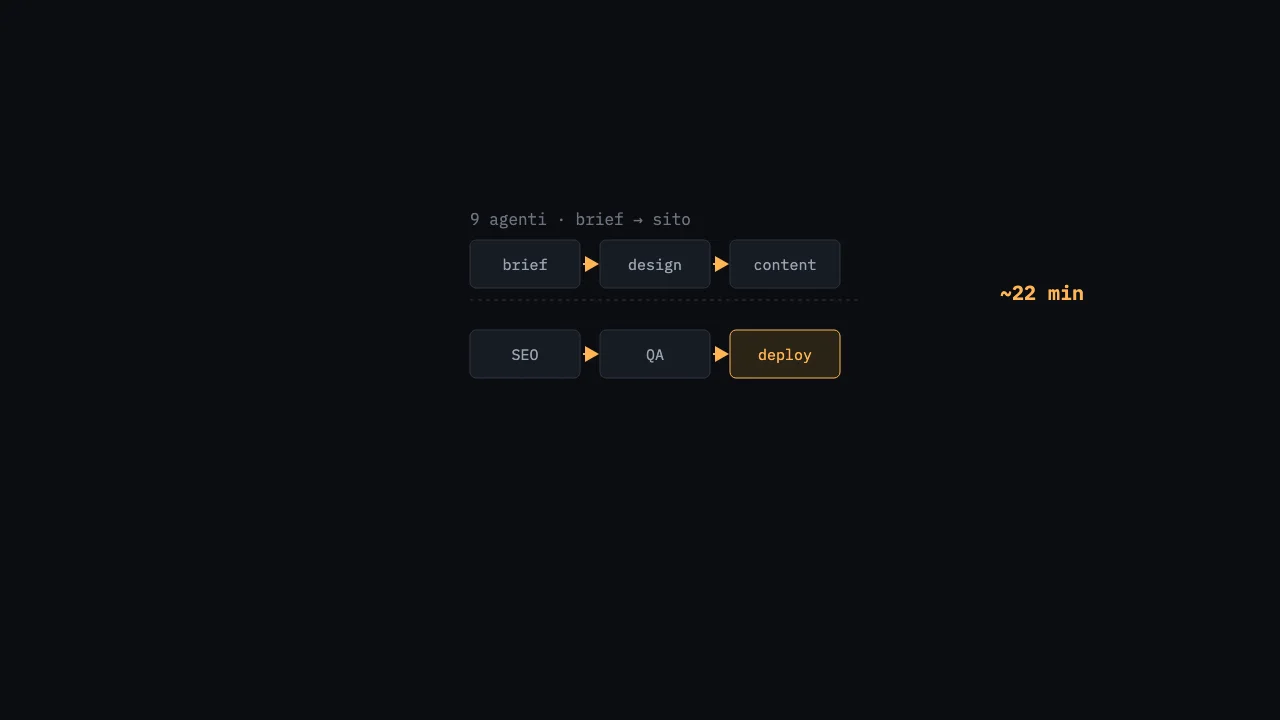
22 minutes to build a WordPress site, two days to make it not look ugly
Technical diary of a 9-agent Claude web agency: from brief to live Divi 5 site in ~22 minutes on bare-metal k8s. The lesson: automating the plumbing is…
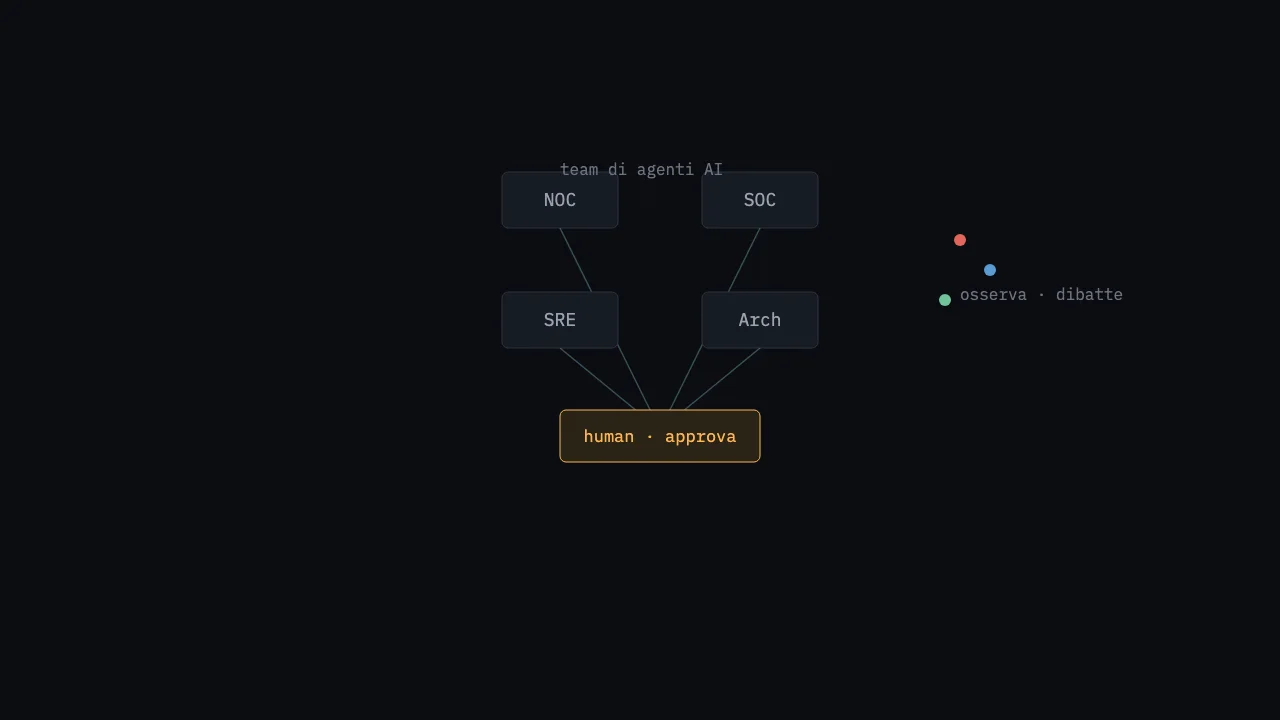
The IT department that argues with itself: three layers and a human in the loop
An IT department made of AI agents — NOC, SOC, SRE, Architecture Board — that watch a k8s cluster, rebut each other and prepare decisions for a…
Geena hears my Mac better than me: 7 “Gina”s out of 40
Technical diary of a voice assistant on a Raspberry Pi 5: barge-in at 0.72 s, speaker recognition, a local model that got rejected, and a wake word that can't hear me.