./run 59-percento-tre-strati-agenti-agno
The 59%: why I stopped letting the LLM do everything
Diary of a multi-agent scaffold on Agno: three layers directive/orchestration/execution, natural-language SOPs on top, deterministic Python underneath…
- status
- poc
- project
- agno-agents
- updated
- 2026-07-08
- tags
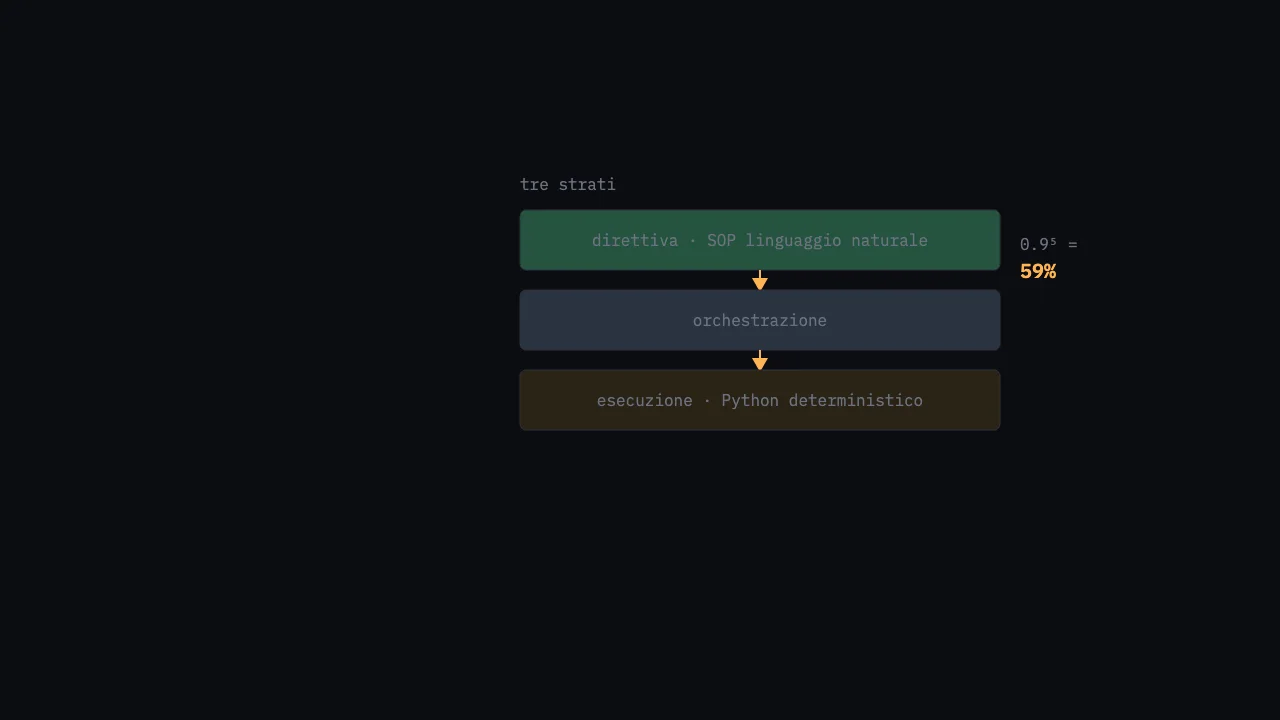
Take five steps with an LLM, each one 90% reliable. How much comes through intact? 0.9^5 = 0.59. Fifty-nine percent. In practice: a five-step agentic pipeline that’s “almost always right” fails two times out of five. That number — which isn’t mine, it’s trivial arithmetic — is why I spent a weekend building a scaffold that takes work away from the LLM instead of giving it more.
The idea
agno-agents is a personal scaffold for multi-agent automations built on the Agno framework (v2.5+). But the core isn’t Agno: it’s an architectural rule I imposed on myself, written down in black and white in the project’s CLAUDE.md. Three layers, separated responsibilities:
- Layer 1 — Directive (what to do). SOPs in Markdown inside
directives/. They’re natural-language instructions, written the way you’d give them to a mid-level employee: goals, inputs, tools to use, expected outputs, edge cases. - Layer 2 — Orchestration (deciding). This is the LLM. Its only job is intelligent routing: it reads the directive, calls the right scripts in the right order, handles errors, asks for clarification. It doesn’t do the dirty work.
- Layer 3 — Execution (doing). Deterministic Python scripts in
execution/. API calls, I/O, database. Testable, fast, repeatable.
The sentence I keep pinned up: you don’t scrape the site yourself — you read directives/scrape_website.md, prepare inputs and outputs, then launch execution/scrape_single_site.py. The LLM isn’t the bricklayer, it’s the foreman.
How it actually works
On top of these three “philosophical” layers runs a second, more concrete pattern: a meta-team that builds other teams. There’s an Architect Team (Tier 1) of 4 agents — Analyzer, Designer, Soul Writer, Builder — that takes a prompt like “I need a team that writes Instagram posts for hotels” and spits out a deployable project: a SOUL file, a YAML manifest, and the DB registration. Then the Task Team (Tier 2) actually executes.
The piece I like best is how the nested teams are wired in team_factory.py. A sub-team of workers who collaborate, and a sub-team of reviewers who instead must not collaborate:
# Workers: share context, build on each other
work_team = Team(
    name=f"{manifest.project_id}-workers",
    mode="coordinate",
    members=worker_agents,
    share_member_interactions=True,   # <-- they see each other's work
    ...
)

# Reviewers: broadcast, each blind to the others
review_team = Team(
    name=f"{manifest.project_id}-reviewers",
    mode="broadcast",
    members=reviewer_agents,
    share_member_interactions=False,  # <-- no groupthink
    ...
)
That share_member_interactions=False on the reviewers is a deliberate decision: if the reviewers see each other’s scores, they converge. I wanted independent opinions, so each reviewer sees only the original output, gives a score 0-100, and the leader synthesizes. If even a single one is below threshold, the work goes back. The threshold isn’t a magic number but depends on the domain: 70 for marketing, 75 for research, 80 for code, 85 for legal/compliance. The higher the stakes, the meaner the gate.
Each agent is defined by a SOUL — a YAML validated by a Pydantic model (SoulConfig) that becomes the agent’s personality and constraints:
name: quality-reviewer
display_name: The Hawk-Eye
role: Quality Reviewer
communication_style: blunt
is_reviewer: true
review_score_threshold: 80
review_criteria:
  - "Accuracy: are the facts correct and cited?"
  - "Clarity: is the writing clear and structured?"
constraints:
  - "Approving work without specific, actionable feedback."
Underneath is the rest: 3 providers (openai gpt-4o/mini, anthropic sonnet-4/haiku-4.5, ollama local), a TOOL_REGISTRY of 12 tools resolved dynamically by name, SQLite for per-project memory, and a FastAPI dashboard for the final human approval. About 3,300 lines of Python in execution/ alone.
The hard call: two human-in-the-loop gates
The temptation, when you build agentic stuff, is auto-approval. “The reviewers said 88/100, ship it”. I chose the opposite: no output is complete until a human signs it off. Two gates in sequence — automatic peer review, then human_approval_tool which serializes the entire deliverable to JSON and queues it on the dashboard. And if the work fails 3+ rounds of review, the leader stops digging in and calls notify_human_tool with urgency high. No infinite loops burning tokens in silence.
Is it slow? Yes. But the whole point of the scaffold is that I don’t trust the LLM for the deterministic things, and I don’t trust the LLM reviewers for the final OK either. Consistency is guaranteed by Python; the final judgment is guaranteed by me.
Honest gotchas
A project is credible when it admits where the README and reality diverge. Here they diverge in three places:
data/projects/is empty. The scaffold knows how to generate and run a team, but I haven’t yet committed an end-to-end project that was born from the Architect and produced an approved deliverable. The meta-team is code + documentation, not yet a demo that runs.- Three “mirror” files, but one doesn’t exist. At the top of
CLAUDE.mdit says “mirrored across CLAUDE.md, AGENTS.md, and GEMINI.md”.CLAUDE.mdandAGENTS.mdare byte-identical —GEMINI.mdisn’t there. Documentation that describes an intention, not the state. - The key that leads nowhere. The
.envexposesGOOGLE_API_KEY, but the provider registry inconfig.pyonly knowsopenai,anthropic,ollama. Google is wired into the environment but not into the code. - Infrastructure bonus: there are complete k8s manifests (Postgres, ingress, networkpolicy) for a system that hasn’t yet run a single real project. I scaffolded the deploy before the product — the classic mistake.
There’s also a conceptual tension I keep in mind: the “three layers” of the philosophy (directive/orchestration/execution) and the “two tiers” of the runtime (Architect → Task Team) are two different maps of the same territory. Convenient for me, potentially confusing for anyone else who opens the repo.
How it’s going
POC, honestly. A single commit, “full implementation”, which is more a dense scaffold than a product. The pieces are there and they stand up: config, security (path validation, secret redaction with regex, guards against path traversal), team factory, SOUL loader, dashboard. What’s missing is the mileage: running it enough to discover where it actually breaks, and then self-anneal — which is the part of the CLAUDE.md where I promise myself to update the directives every time I learn something. So far I’ve only learned by writing it.
What I learned
- The 59% is the thesis, not a detail. Every decision in the scaffold — SOPs in Markdown, deterministic scripts, multiple gates — exists to move steps out of the “probabilistic” column and into the “deterministic” one. The fewer steps you entrust to the LLM, the higher that number climbs back toward 100%.
- Separation of concerns is easier to write than to respect. It’s tempting-easy to let the LLM do “just a little scraping” in orchestration. The discipline is saying no and writing the script.
- Reviewer independence is a boolean flag.
share_member_interactions=Falseis one line; the groupthink avoided is worth much more. - Scaffolding the deploy before having a real output is vanity. My k8s manifests are more mature than my empty
data/projects/folder. The next useful line of code isn’t in Kubernetes: it’s the first project that’s born, runs, and gets approved for real.
grep -rl 'same thread' ~/lab
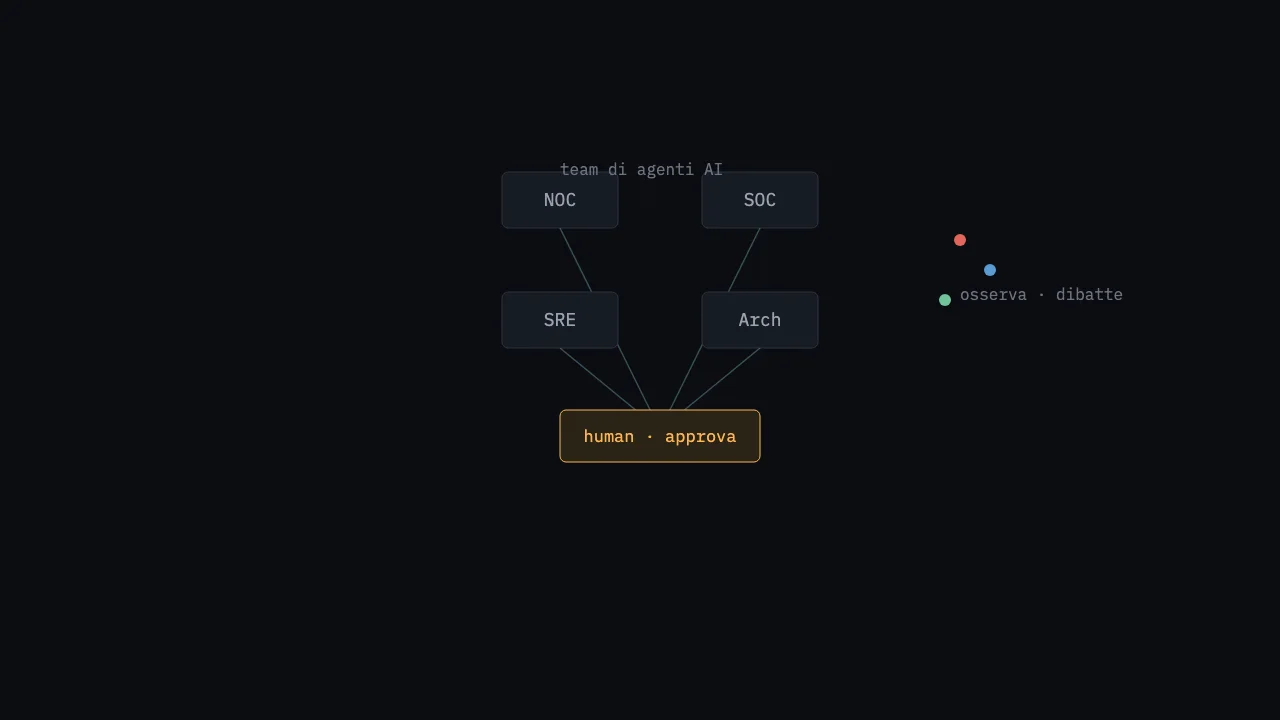
The IT department that argues with itself: three layers and a human in the loop
An IT department made of AI agents — NOC, SOC, SRE, Architecture Board — that watch a k8s cluster, rebut each other and prepare decisions for a…
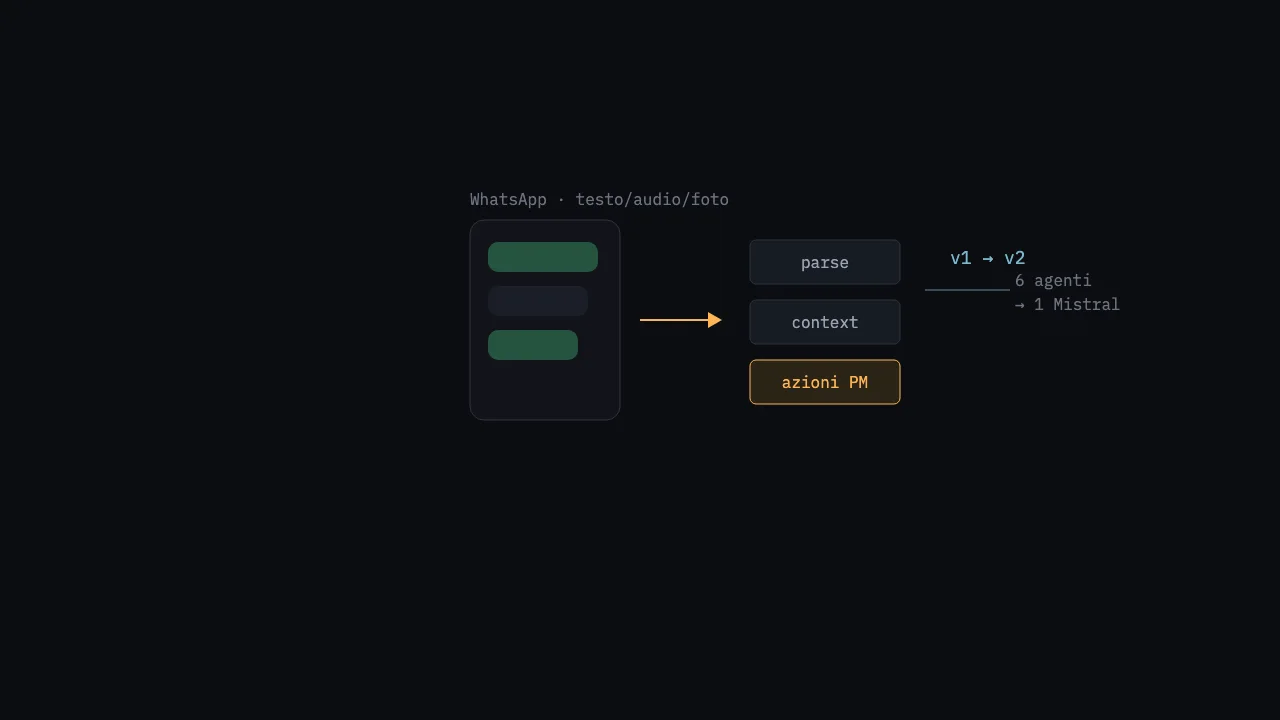
Pragma, twice: I threw out six agents and two databases, and gained a feature that weighs 1
I rebuilt a WhatsApp project-management assistant for the public sector from scratch: from six agents and three databases to just one. A diary on which complexity…
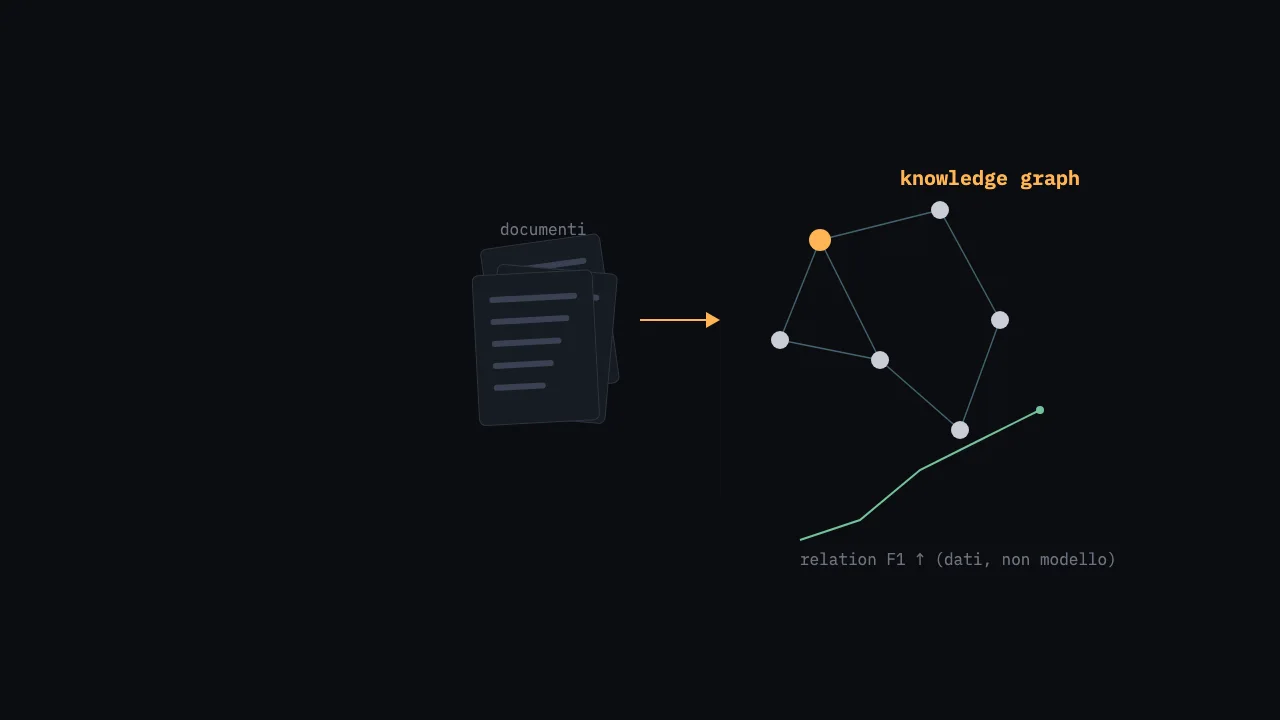
Relation F1 at 0.38: when the lesson wasn't the model, but the data
Technical diary of a fine-tuning: LoRA on a 27B model to extract knowledge graphs from messy documents. The turning point wasn't a bigger model…